April 10, 2012

Word for Windows


When I told you about doing the booklets for Noam, I was not telling the whole truth. The whole truth is that we had to print out all of the booklets on a windows computer before we could do the graphic design in Kibbutz Hannaton.
So we had everything in Word for windows 2.0 the Hebrew version (back in the day they had to make a Hebrew version for every word processor, apparently now they don't, at least not for Microsoft word...)
It was a terrible piece of software. It got stuck even on very small files, and our files were not so small (though we did split every booklet to at least four files, which meant we had something like 24 files to print). for some reason, even though the files were only something like 20 pages each, it would not print more than about five at a time...
We did it all on Friday, and just finished in time for Shabbat...
That was 1994.
As these things go, we had to do a complete rewrite of the booklets by 1995, and print them out again. This time it was really easy. Everyone (the writers, the designers, me, the printers...) had Hebrew Word for Windows 5.0 (I'm not saying they were all legal copies...)
But we had no problems at all. We could do nifty graphic design (Columns, pictures...) and we could print 20 page files no problem.
That's when we finally switched to Windows, and didn't have to go to Kibbutz Hannaton to print...


April 4, 2012

Windows 3.1


Back in 1993, Israel has started the Oslo peace process with the Palestinians, and me and my girlfriend moved to a new apartment. These were heady exciting days...
1993 was second year university (the Hebrew University in Jerusalem) for both of us, and during the first year we both lived in the dorms, she with a friend (female), and me with five roommates (all male). This was also fun, but second year we wanted to really try being a couple. 
I hope I won't sound really weird by saying that one of the advantages was that we had her computer. I can only justify this by saying we needed a computer for our studies (me sort of, she really), and that we both worked on it for our jobs (informal Jewish education, we sort of worked together).
Anyway, in the 1990s Israel was known as the one diskette country. That meant the Microsoft for example sold one copy of each piece of software. I just 'obtained' a copy of Microsoft windows 3.1 (from the office we worked in...) and installed it on our (hers really) computer.
What can I say. It was a good operating system. You can see for yourselves in the picture above...

March 29, 2012

King's Quest V - Absence Makes the Heart Go Yonder


The Wikipedia Article about this game says that is came out in November 1990. Dunno about that. All I can say is that my girlfriend had it on her DOS computer at her home, when I was in the IDF, and later in Kibbutz Hannaton.
That means we played it over weekends and holidays (though not on Shabbat...). I think she got it for me for my 21st birthday, so late 1991. I'm pretty sure we finished it almost exactly a year later, just the day before Yom Kippur 1992.
So back in the day we were devoted to point and click adventure games, and also it was so much harder to find the answers to the riddles. I do remember that we did have some way to find the answers, especially to the end part, where you have to turn to all sorts of animals. I just can't, for the life of me, remember how we had that, because there was no internet at the time.
It had cost 120 NIS at the time, which is something like 40$ today, not bad for a year of entertainment...


March 22, 2012

MS DOS Can Set You Free


Just so everyone will know what I'm talking about. DOS - stands for Disk Operating System, and MS stands for Microsoft.
So back in the 1990s all computers came with DOS (Here in Israel litarally all of them came with MS-DOS, but I guess in the US some other flavors such as DR-DOS were at least a little popular...)
Truth of the Matter, I didn't know a lot of DOS, only something like three commands:
  1. DIR meant directory, it showed you all the files (and directories) in a certain directory (now it's called a folder).
  2. CD meant Change Directory. CD.. meant go up one level in the file structure.
  3. Writing the name of an .exe file (something like rayman.exe) ran that file
  4. Oh, and RM removed files, but I was always too scared to use it...
So back in the day, anyone who knew as much as I did could infer the entire file structure of the computer in a few minutes. Sure, there were no impressive icons, and the resolution was not that of the New iPad, but can anyone tell what the file structure of that is?
Kind of makes you wander about Big Brother...


March 13, 2012

Back is 1986 CP/M Was Too Cool For Me


I've already written here before about my Commodore 128. I don't really remember the store I bought it from, only that it looked more like vegetable store than, say, an iStore.
I also don't remember exactly how much it had cost. I think it was something like 300 Canadian dollars. BTW, oddly enough a lot of my Canadian friends did not own computers, and the school certainly didn't (besides the management and the Librarian's computer for the book catalog).
This Commodore 128 came with a floppy disk drive, and I remember I could buy a hard disk for another 300 (Canadian) dollars or so and CP/M for another 300. 
I seriously considered all of this, but I decided against it. I had a little money of my own at the time, but this all seemed like too much, and I had no clear use for it.
Which starts to make my point. DOS was a seriously good invention!

March 7, 2012

Press Play On Tape

So last week I told you all about my first experiences with a computer working on DOS. But let me back up a little. I bet many people reading this do not know that DOS stands for Disk Operating System, and as I said last week I have been working with that since late 1991. So what did we do before that?
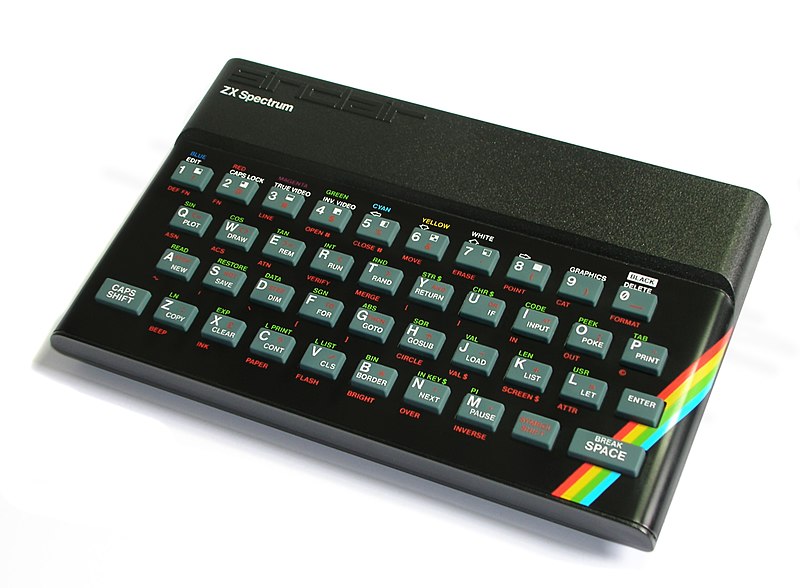
My first computer was a ZX Spectrum (picture below, because it looks kinda cool). My friend Tzachi, who died about 15 years ago, thus far too young, had a Commodore 64 (BTW, C-64 still finds it on Google, yay!).
Both the ZX Spectrum, and the C-64 worked with Audio Cassette Tapes (maybe I should put in a picture of one of these guys too, but in the mean time, Google it).
My ZX spectrum had a whopping 48K of RAM and the C-64 had, well 64.
So if we wanted to play a game we put a cassette in the player, and the computer 'heard' the program (sort of like the old modems).
This was a computer without a Disk Operating System, or indeed a Disk. It knew just one program when you turned it on, usually some version of BASIC. This meant that in order to LOAD your program you had to LOAD it, so we all knew BASIC (or at least the LOAD command).
In those good old days, illegal copying of programs was done with a double cassette tape...
So anyway, one fall day in 1984 me and Tzachi went up to his apartment and we told the computer to LOAD something (I think it was Fort Apocalypse). Whenever you told that to the C-64, it said: 'press play on tape'. so we pressed play on some other tape, and listened to some music. We thought it was funny.


February 28, 2012

An Unexpected Post - Out In The Dark


My friend Michael Mayer just finished making this film.
Come check it out!
http://www.facebook.com/pages/Out-In-The-Dark-%D7%A2%D7%9C%D7%98%D7%94-%D8%B8%D9%84%D8%A7%D9%85/235557469872298?sk=wall

The Einstein Word Processor


It was December 1991, and I was ecstatic. You see, my military service in the IDF was in the Nahal. At the time this meant that a significant part of the service was not in the IDF itself, but in some Kibbutz.
So by December 1991, my 'real' military service was over, and all I had to do was stay at the Kibbutz for several months, and teach kids from junior high schools about the expulsion from Spain (which happened in 1992, so in 1992 we 'celebrated' 500 years).
So we prepared to teach them, and we planned tons of fun activities, and we had to write them down on a computer. This was the first computer I had to use since my high school days (1986) and the Commodore 128.
THE word processor to use back in the day was Einstein writer (see picture above), naturally the computer itself ran on MS-DOS.
I don't know why I knew this, but I knew that before I write anything at all I should read ALL of the help file <Alt H>, so I did.
Never regretted that one.

February 23, 2012

Let Me Start From The End


But first let me explain this picture. When Ehud Barak was the Prime Minister of Israel (1999-2001), he was well known for saying to anyone who spoke at a meeting to 'Start from the End, or Start from the Bottom Line'. I think this exemplifies his somewhat abrasive, but sometimes useful way of thinking, but we have not gathered here to talk of Ehud Barak.
So my 'Start From the End' goes something like this. Last Saturday, I wanted to upgrade my (legally bought) Windows XP to an (illegally downloaded) Windows 7.
I had no problem downloading and installing it. But it ruined my access to the partition of Ubuntu Linux  (11.10) I had.
So no problem. I re-installed Linux, which was a good thing, because I had a zillion partitions, and asked it to install itself on all of the hard drive.
Big mistake. As far as Microsoft is concerned. the shiny new win 7 would not install itself on a partition that is not NTFS. 
Thus, for the first time in something like 17 years, my main computer does not even run Windows.
That tells you something about what I think of Microsoft products right now.
But still, I think Microsoft made some great products over the years, and I have used many of them. 
Let the upcoming series of posts be some sort of a Eulogy to this great company.
And once again, let me Start from the End: I think Microsoft made more great products over the years than Apple has.

February 14, 2012

Trying to Assess the Role of Apple as a Company


I started this series of posts with my review of the Steve Jobs Biography. Walter Isaacson, the writer of the biography, was indubitably impressed with Steve Jobs as a person, and with Apple a a company. While I am also impressed with certain accomplishments of Jobs and of Apple, I don't think that all of the inventions that Isaacson mentions in the biography as world changing really are.
For example the iPod never really made it from where I'm standing, and the iPad is an OK tablet, but I doubt that it will be a major tablet in say five years. The role of Apple and Jobs in portable music players as well as in tablet devices is of innovation and popularization for sure. They are the first company who really made money on these things, but ultimately they are not the ones making most of the money on them.
The same goes for the mac computer and the mouse aided Graphical User Interface (BTW, Malcolm Gladwell makes some really interesting points about this story). They made the macs, but the person who really popularized the Graphical User Interface is none other than Bill Gates. I doubt he'll get a fancy book after he dies, and maybe that is why I plan to discuss my life with Microsoft Computers starting next week.
So What is Apple's greatest product? I think it's the Apple ][, the computer that started the Personal Computer industry, and embraced open technologies!

February 8, 2012

Apple and Foxconn


While in my younger days I was a student of Economics, and all that interested me was economic efficiency, as that would surely increase Justice and Equality in the long run, now I am not so sure that efficiency in the be all and end all of all things economic.
Apple has gotten a lot of fire recently for the conditions of its workers, especially in the Foxconn factory in China. I think that if one consumes any product, it is certainly a legitimate interest how the workers making this product feel, how many hours they work in a day etc.
I also think that China is probably very happy to have the Foxconn factory, and that overall Chinese people including the majority of the workers in the factory are happy working in it. I hold these opinions after reading some articles about these issues, but your mileage may vary.
Furthermore, for some reason Apple is being criticized for the working conditions in Foxconn, and yet other US tech companies are not. I find this very weird.
So far I think that This American Life have managed to show the most complex and interesting picture of this story.
Having said all that, I think that the picture painted by the Steven Jobs Biography, of Steve Jobs as a 1960's hippie is plain ridiculous if he had known half of what we know about Foxconn, and if he didn't know, he had no excuse for not knowing.

February 3, 2012

Personal Good News


I'm sorry, that I did not post on time this week. On the excuses side, I now have a newborn son!
The above picture is for illustration purposes only, I think I'll let him decide when to upload pictures, which should take at least a week or two.
He is healthy, happy most of the time, and weighs a bit more than seven pounds. His mother is also fine, though the birth itself was not the easiest thing in the world, probably it was harder for her than it was for me.
I think I'll have more to say about the birth itself in a future series of posts about science, but that would probably take at least a few months.
Anyway, next week I hope to be back on schedule, and keep discussing Apple, and soon we'll get to Microsoft...

January 24, 2012

A Surprising Conclusion

Honestly, when I started writing this series of posts, or even when I wrote last week's post, I did not think that this would be the conclusion of this series of posts about me and the different Apple products I use, but here it is:
I think my next desktop is going to be a Mac Mini.
The reason for this is the new iBooks software and the new authoring tools issued by Apple.
Now the funny part, the part that made me think a lot is why I'm going to do this. You see, I'm annoyed about the Apple EULA as much as the next guy, and I'm annoyed at the fact that I can't BUY books from iBooks (or from Google Books for that matter) probably more than the next guy.
So why am I willing to go along with this?
For two main reasons:
  1. I think the books that I plan to write and sell are important enough that I will use the best available (and cheap or free) tools to make them.
  2. I'm sure I can use the Apple software and then somehow export the files to a format that I can sell on other bookstores.
This whole thing taught me that I have my own ideology, and that it is not directly related to Apple's 'Style' ideology, or the Linux 'Open' ideology. I mean I don't mind Style, and I certainly don't mind Open, but this is not what I'm about.
What am I about? we'll get to that in a few months...


January 17, 2012

How I Got an iPhone 4

So I had my iPhone 3GS for almost a year, not a bad machine, like I said last week.
Then my daughter had this great idea on one of the cooler days last October. Why not go to Anabeh park? I liked this thought: I spend one afternoon a week with my kids (my son likes to play with my iPhone at least half that time), and the Anabeh park is a mere 20 minute walk from their school.
Here is a picture of the park:


See the lake in the middle? That's our suspect. Because right after we rented a boat (again my daughters' idea) see suggested that we steer it so that we'll be at the business end of the fountain that you see in the middle of the lake. Even though my phone was in a fairly watertight bag it started acting funny after that.
I asked for it to be sent for a checkup at the lab, next thing I know I get an iPhone 4 back!
Needless to say I was very pleased, and the rest of the staff at my cell carrier were a bit pissed: "How come you got that, and we didn't? What did you say was your problem? What was it exactly? We want to say the same thing!"
What can I say, the iPhone 4? Not a bad machine.

January 10, 2012

What Can I Say? The iPhone is a Good Product!


So on November 2010, I walked into an Orange (the name of my Israeli cell carrier) store, and told them I was tired of my Nokia 5800 'smartphone'. I won't go into the details of why I did not love it, but I didn't. I asked them if they could offer me something better.
They said sure. Because I was a student I could get an iPhone for 149 shekels a month (about 40$), and if I talked that amount I would pay no extra charges. At the time I was really in awe with Google (more about Google later in this series), so I asked if there were any Android smartphones available. There were, but they were more expansive. I have no idea how that made economic sense, but only about now Android phones and tablets are beginning to be cheaper than their iOS counterparts here.
So I said, OK I'll get an iPhone (3GS). I've had it for about a year (now I have the the iPhone 4, but more about that next week). 
Though some people are not too thrilled that I can't be reached whenever I'm next to my children (because they play with it), it's a good machine.
I've bought apps, I've bought Kindle books and read them on it, I took some really good pictures (not on any artistic level, just pictures I'm happy with). I can read mail. I'm very pleased.
It's the first Apple product that I actually owned, and I like it.
But does it live up to the hype? I'm not so sure!
So once again, it's hard to call something 'insanely great', because we are all looking for different things, and facing different limitations (remember no iTunes here, but also severely limited podcasts, no buying videos etc.)
So going back to the subject of these posts, Steven Jobs.
There can be little doubt that the man pushed the envelope, with the iPhone, with the iTunes store, with the original mac etc. but other guys pushed too, and some of them were nicer, or just plain pushed harder IMHO.
Steve was one of the good guys (in terms of contribution to society), but I don't think that he was the BEST or anything like that.